Wingfoiling Tenerife: Spots, Wind and Seasons
El Médano gets trade wind almost daily from April to September. Here is where to ride on Tenerife, when to go, and which spots to leave to the locals.
WINGFOIL · SPAIN · CANARY ISLANDS · CHOP, FLAT & WAVES · INTERMEDIATE AND UP · BEST MONTHS APRIL TO OCTOBER
Tenerife is the one European destination where you can plan a week of winging in February and still expect to get wet every day. The island sits right in the path of the northeast trade wind, and the south coast around El Médano funnels it into something you can set your watch by. Most of the year the wind shows up between late morning and mid afternoon and blows 15 to 30 knots, and the water stays warm enough for a shorty. Two honest catches. This is not the place to actually learn, because the bay is choppy and the wind is often a touch too strong for a first session. And El Cabezo, at the north end, belongs to the windsurfers first. Nobody kites there, and winging is for genuinely good riders only. The rest of the bay is open to everyone. If you can already ride upwind and get yourself home, you will have one of the best weeks of your year here.
In this guide: the wind, the bay and its sub spots, what gear to pack, seasons, schools and rental, and riding up the Teide on your no wind day.
Quick glance
| Best for | Intermediates and up. You should be past the absolute beginner stage before you book. |
| Wind season | March to October, with April to September the reliable core. Winter delivers too, just less often. |
| Water type | Chop across the bay, longer swell lines further out, real waves at the harbour wall. |
| Typical wind | Northeast trade wind, side onshore from the left, 15 to 30 knots. Rare days push 35 to 40. |
| Wetsuit | Shorty or 3/2 most of the year. A 3/4 is comfortable in winter. Water runs 19°C to 23°C. |
| Wings | 3.0 to 5.0. You will use the 3 and the 4 far more than anything bigger. |
| Where to start | El Médano. Filter the map by water type and wind direction. |
The wind
Tenerife runs on the alisios, the northeast trade wind that pushes down the Atlantic from the Azores high. On the south coast it does something useful: the wind splits around the mountain range in the middle of the island, accelerates down both flanks, and reconverges over the southeast corner. El Médano sits exactly in that reconvergence zone. That is why the bay can be lit while the airport five kilometres away shows almost nothing.
The realistic range is 15 to 30 knots. That is the band you will ride in on most days of a normal week. A few days a season it goes further and you get 35, occasionally 40. Those days are rare, but they happen, and they are worth knowing about before you pack. If you are the kind of rider who wants to be on the water in that, bring something small.
Direction matters as much as strength. At El Médano the trade arrives side onshore from the left, which is what makes the bay safe to ride even when it is honking. A ten degree shift can take the spot from firing to unrideable, and the locals talk about it the way other people talk about rain. When that happens the answer is usually to drive, not to wait.
Then there is the part the models miss. El Médano is a thermal spot. The land heats up, the gradient wind gets a boost from the sea breeze, and the bay fills in around 11:00 while the gradient forecast still reads 10 knots. Sessions typically run 11:00 to 18:00. If you only look at the morning gradient number you will write off days that turn out to be some of the best of the trip.
Honest note on the off days: the trade wind is not on every single day, and December through February can hand you a run of three or four still days in a row, usually when a low pressure system parks west of the islands. Those are also the days the swell shows up on the north coast, which is not the worst trade.
El Médano
Almost everything you will ride on Tenerife happens inside one bay, and it has enough variety that you never really need to leave it. El Médano is a long sandy beach with a sandy entry, a town you can walk out of in your wetsuit, and a few distinct pieces of water depending on how far along the beach you go and how much wind there is.
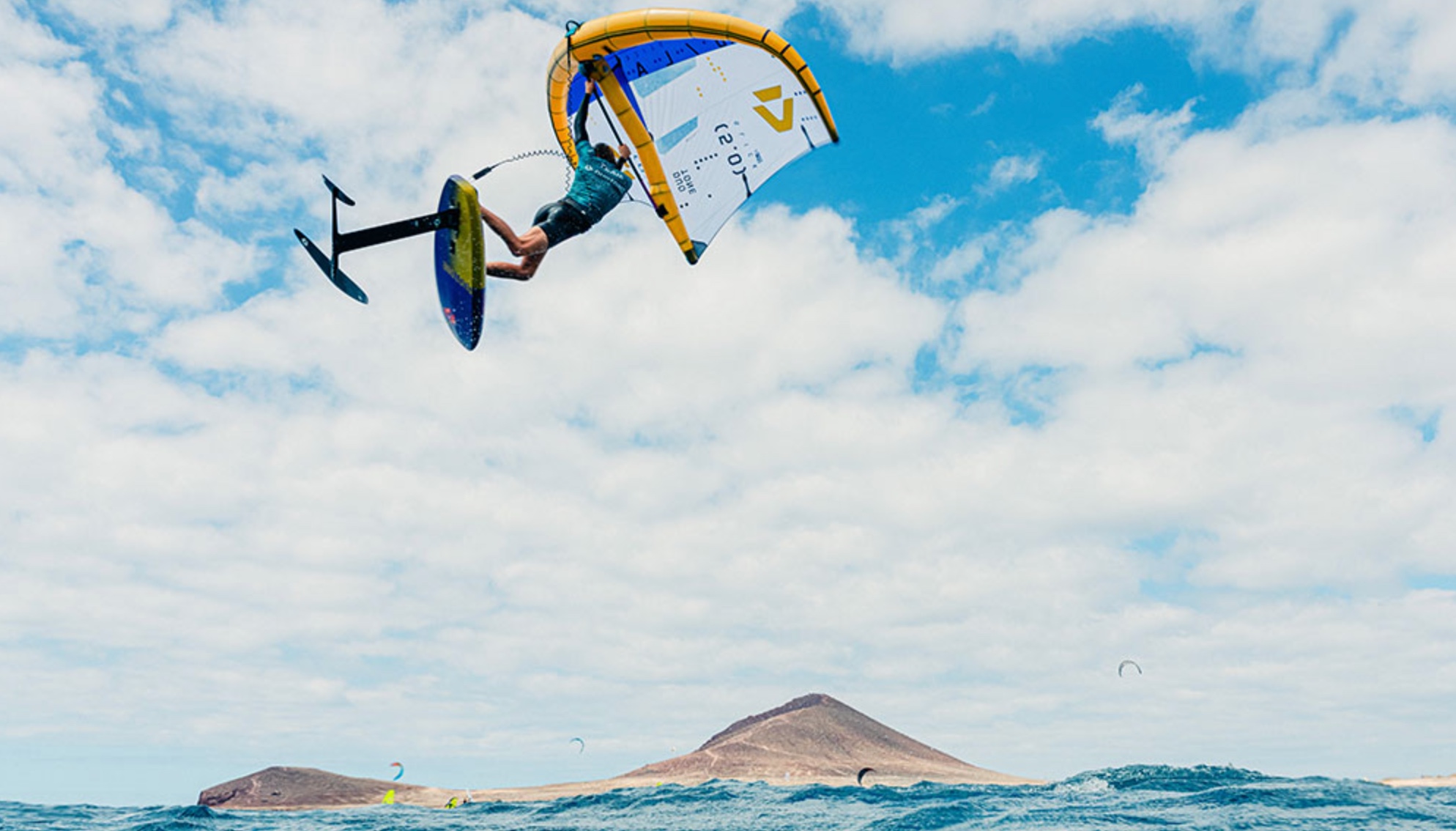
Set your expectations on the surface. The bay is chop, not glass. Further out it opens into longer swell lines that are genuinely good for flat water jumps and short downwind runs back toward town. That chop is exactly what makes it a poor place for a first ever session and a very good place to sharpen up. Once you are riding, it punishes lazy weight distribution without punishing you, which is what you want when you are working on tacks on foil and duck gybes.
Family wise it works better than most wind destinations. The inner corner of the bay is flatter and shallow enough that kids can mess about in the water while you rig, and everything is a short walk from the apartments and the cafés. Be honest with them about one thing: that inner corner is gusty. Flat does not mean calm here.
Cruz Roja run a rescue service over the bay at no cost to you. That is a real safety net, and you should not assume it exists anywhere else on the island.
The harbour wall
About ten minutes upwind of the main beach, the wall shapes the swell into the closest thing to a proper wave ride you will get without driving anywhere. When it is working you get four or five bottom turns and top turns out of a single wave, which for a wingfoil is a lot of face.
It needs wind, roughly 25 knots and up, and it needs respect. Lava reef sits close to the wall, and at high tide the waves break nearer the structure than you want them to. Watch a set before you commit.
El Cabezo
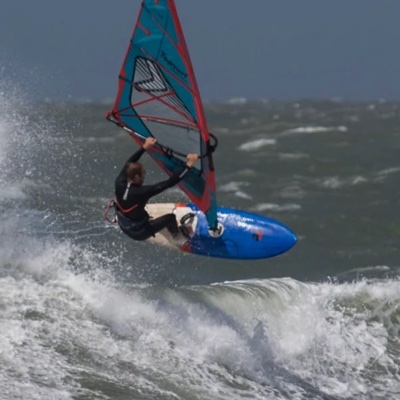
At the north end of the bay sits El Cabezo, and it belongs to the windsurfers first. It is a windsurf institution, home break to Dany Bruch and Alex Mussolini, and it hosts World Cup events in August. Nobody kites there. Winging is possible, but only if you are genuinely good. The wind is stronger than in the bay, the waves have real shape, and the entry and exit are rocky rather than sandy.
If you are on the fence, you have your answer. Ask at one of the schools in town before you rig and they will tell you straight. One thing to know either way: a large rock, known locally as the Godzilla rock, sits roughly twenty metres inside the entry point.
If you feel like driving
You do not need to leave El Médano. Most people do not, and the ones who do usually come back saying the bay was better anyway. But a rental car is worth having, and there are three places worth a look if you want a change of scenery or the direction has gone wrong in town.
Playa del Medio is the flat water option, a small bay with a harbour mole that behaves like a lab for gybes and tricks. The wind is lighter there than in the main bay and the bottom is stony, so bring booties. Open in Google Maps
La Tejita is the two kilometre undeveloped beach behind Montaña Roja. Golden sand, no buildings, no crowd. The catch is the wind: sideshore to side offshore, so a gear failure sends you out rather than in, and there is no rescue boat watching. Open in Google Maps
Puertito de Güímar is thirty minutes up the coast and works on north to northeast, which is often the exact direction that kills El Médano. Rocky bay, lava, concrete platforms, no facilities. Not a pretty place to ride, but a useful one on the day your forecast falls apart. Open in Google Maps
What to pack
Wings from 3.0 to 5.0 covers Tenerife completely. Anything bigger stays in the bag, so leave it at home.
The honest calibration, from a full week on the island at 93 kg: a 4.0 got used every single day, and on a good few of those days it was too much wing. A 3.5 would have been the better call. So build your quiver around the small end. A 4.0 as your everyday, a 3.5 or a 3.0 for the days it builds, and a 5.0 for the softer thermal afternoons.
For the wetsuit, a shorty or a 3/2 covers you from spring through autumn. In winter the water sits around 19°C and a 3/4 is a lot more comfortable than toughing it out in a shorty, especially on a four hour day. Booties if you plan to ride Playa del Medio or poke around the rockier entries.
Seasons: when to go
April to June. The best window of the year, and the one to book if you have a choice. The trade wind is stabilising into its summer pattern, air sits around 22 to 25°C, the water is coming up from its winter low, and the island is not yet full.
July and August. The strongest and most consistent wind of the year, and also the busiest water and the highest prices. If you like being powered up and do not mind sharing, this is your slot. The World Cup lands at El Cabezo in August, which is worth planning around whether you want to watch it or avoid it.
September and October. The other sweet spot. Wind is still doing its thing well into October, water hits its warmest at around 23°C, and the summer crowd has gone home. If someone asks us for one month, we say September.
November to February. Quieter, cheaper, and more variable. You will get excellent sessions and you will get flat days, and you cannot predict which in advance. Air stays around 20 to 22°C, water drops to about 19°C, so this is the 3/4 season. It is also when the Atlantic swell hits the north coast properly, so bring a surfboard as a backup.
March. The transition. Wind starts building back toward the summer pattern. Reliable enough to book, cheap enough to be worth it.
Schools, rental and repairs
El Médano has one of the densest concentrations of wingfoil services in Europe. Worth using even if you are not taking lessons: they will tell you what the bay is doing today and where you should not go.
Lessons and rental
- Tenerife Wingfoil, wingfoil specific, lessons and rental
- TWS Tenerife Windsurf Solution, lessons, rental and shop
- Duotone Pro Center Tenerife, lessons and rental
- Sognicanarias Watersports, lessons and rental
- PKS Tenerife, lessons and rental
- Kitesurf 313 El Médano, lessons and rental
- Sunset Kite Center, lessons and rental
- Azul Kiteboarding, lessons and shop
Rental and shop
- Wind Center Playa Surf, rental
- Godzilla Surf Shop El Médano, lessons, rental and shop
If you ding a board or fold a foil mast, you are in a good place for it. Several of the shops above handle repairs in town, which is not something you can count on at most destinations.
A note on downwinders: the run from the north end of the bay back down past the harbour is a natural downwind line and people do it. There is no boat operator running organised shuttles on Tenerife in our database yet, so arrange your own and tell someone your plan.
The no wind day: riding up the Teide
This is the part that makes Tenerife different from every other winter wind destination. The island has a 3,715 metre volcano in the middle of it, and it is one of the best road climbs on earth.
From El Médano the ride to the Teide is roughly 54 km of continuous climbing with about 2,600 metres of elevation gain, averaging 4.2%, up through Granadilla and Vilaflor on the TF-21. It never gets savage. The maximum gradient is about 13%, so it is not a wall, it is a very long, very steady drag that goes on for three hours and changes the landscape underneath you four times: banana terraces, then pine forest, then the moonscape of the Cañadas caldera, then the cone itself.
Pros have been coming here for years and they keep coming. Sky and Ineos, Movistar and Jumbo Visma have all run pre season and pre Grand Tour camps on exactly this climb, and the reason is the Parador hotel. It sits at 2,152 metres inside the national park, which means riders can sleep at altitude and train at altitude without descending. Expect to lose something like 5 to 8% of your sea level power up there. That is the point.
Practical stuff. The roads are excellent and the surface on the TF-21 is smooth the whole way. Start early, ideally between 07:00 and 08:00, because traffic builds noticeably after 11:00 on weekends and the coach tours to the cable car come up mid morning. Take proper layers: it can be 24°C when you leave the coast and 8°C at the top, and the descent is long enough to get genuinely cold. Rentals in the south run roughly 25 to 90 euro a day depending on the bike, and hire bikes come with compact gearing for a reason.
The other route worth knowing runs from Los Cristianos, 51 km and 2,808 metres of climbing at 5%. Steeper, more climbing, and the busiest of the five ways up. Best months on the bike are March to May and September to November, which overlaps nicely with the best wingfoil windows. Summer is hot on the lower slopes and the park gets crowded.
More Canaries, more wind
If Tenerife hooks you, the rest of the archipelago is a short hop. Sotavento Beach on Fuerteventura is the flat water lagoon that everyone eventually goes to. Famara Beach and La Santa Lagoon on Lanzarote give you waves and flat within twenty minutes of each other. Corralejo Bay is the easy first step across.
And if you want a European destination with a similarly odd relationship between forecast and reality, our Corsica guide covers a place where the thermals lie in the same way.
Before you book
Tenerife works because the wind is boring in the best sense: it turns up, it does the same thing, and you can build a week around it. What you have to bring is a small quiver, enough skill that the chop is fun rather than a problem, and the sense to leave El Cabezo to the windsurfers.
Not sure you are there yet? Read our honest timeline on learning to wingfoil first, then book Tenerife for the trip after.
El Médano turns up almost every day, and that is worth more than any hidden gem.
Is Tenerife good for beginner wingfoilers?
How much wind does El Médano get?
What size wing should I bring to Tenerife?
What wetsuit do I need on Tenerife?
Can I wingfoil at El Cabezo?
When is the best time to go?
Written by
Reinoud
Wingfoiler, lifelong windsurfer and kiter and founder of GUSTY. Based in Muiderberg, on the water at Wijk aan Zee, Muiden, Almere Poort and all over Zeeland.
More about Reinoud →