A Full Guide to Wingfoil in Sardinia
The insider's guide to wingfoil in Sardinia — best spots, where to learn, family beaches, wave action, boat trips, seasons and all the winds explained.
Few destinations in Europe match Sardinia for raw wingfoil potential. The island sits in the heart of the Mediterranean, shaped by two dominant wind systems that push the annual wind day count past 300 in the best spots. Mirror-flat lagoons in the southwest, powerful reef breaks on the western coast, thermal breeze firing up the east coast through summer — Sardinia has every version of the sport packed into one island. Turquoise water, year-round sun, and a local wing scene that has quietly been one of the continent’s best-kept secrets. Not anymore.
In this guide:
1. The most popular spots • 2. Best spots to learn • 3. Family-friendly spots • 4. Wave spots • 5. Seasons & when to go • 6. The different coasts • 7. Boat trips • 8. The winds
1. The most popular spots • 2. Best spots to learn • 3. Family-friendly spots • 4. Wave spots • 5. Seasons & when to go • 6. The different coasts • 7. Boat trips • 8. The winds
The Most Popular Wingfoil Spots in Sardinia
Sardinia has spots that regulars keep quiet about and spots that everyone already knows. The ones below are in the second category, popular for the obvious reason that the conditions are simply exceptional. Each one has a different flavour, and most riders end up visiting all of them on the same trip.
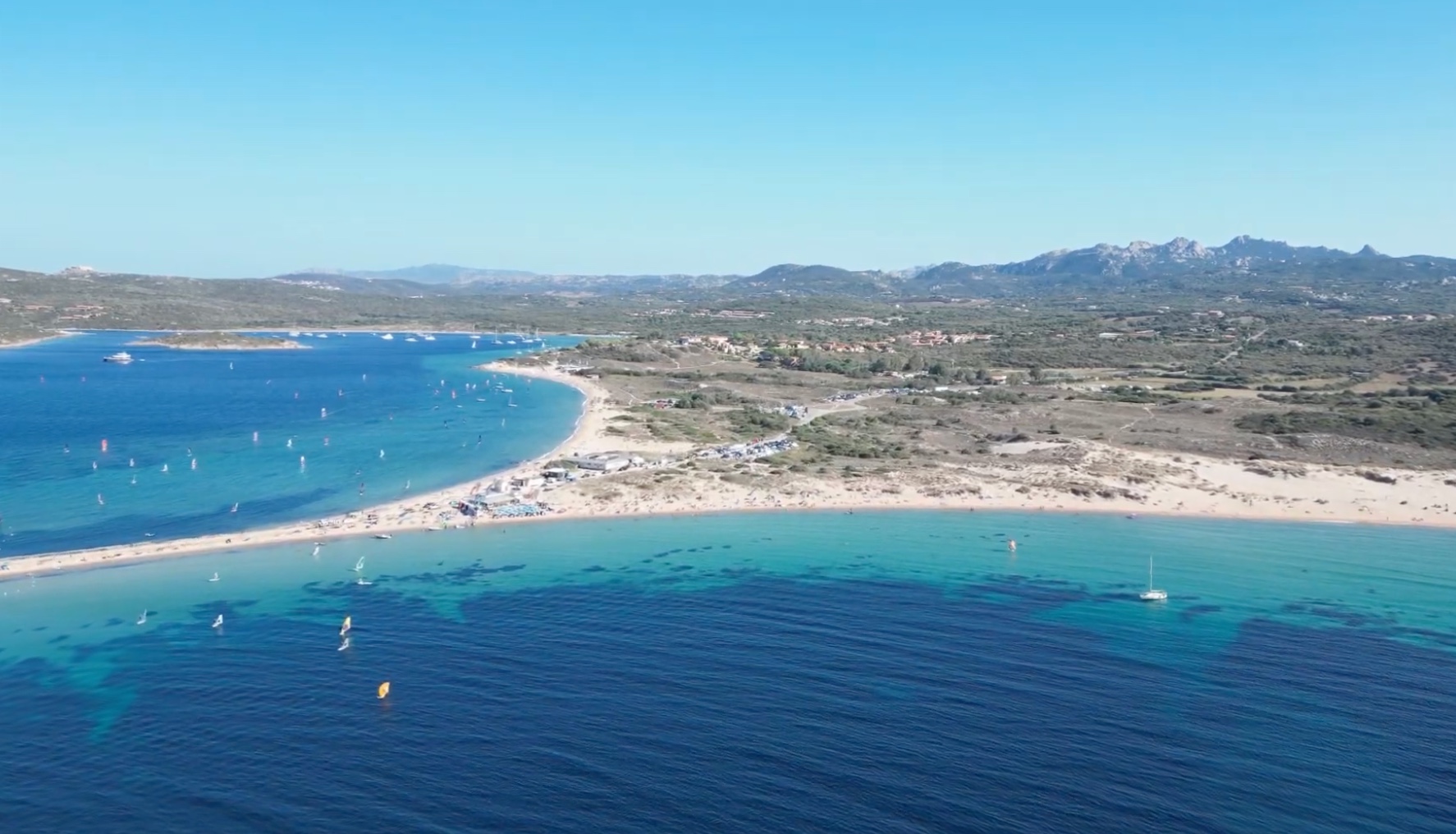
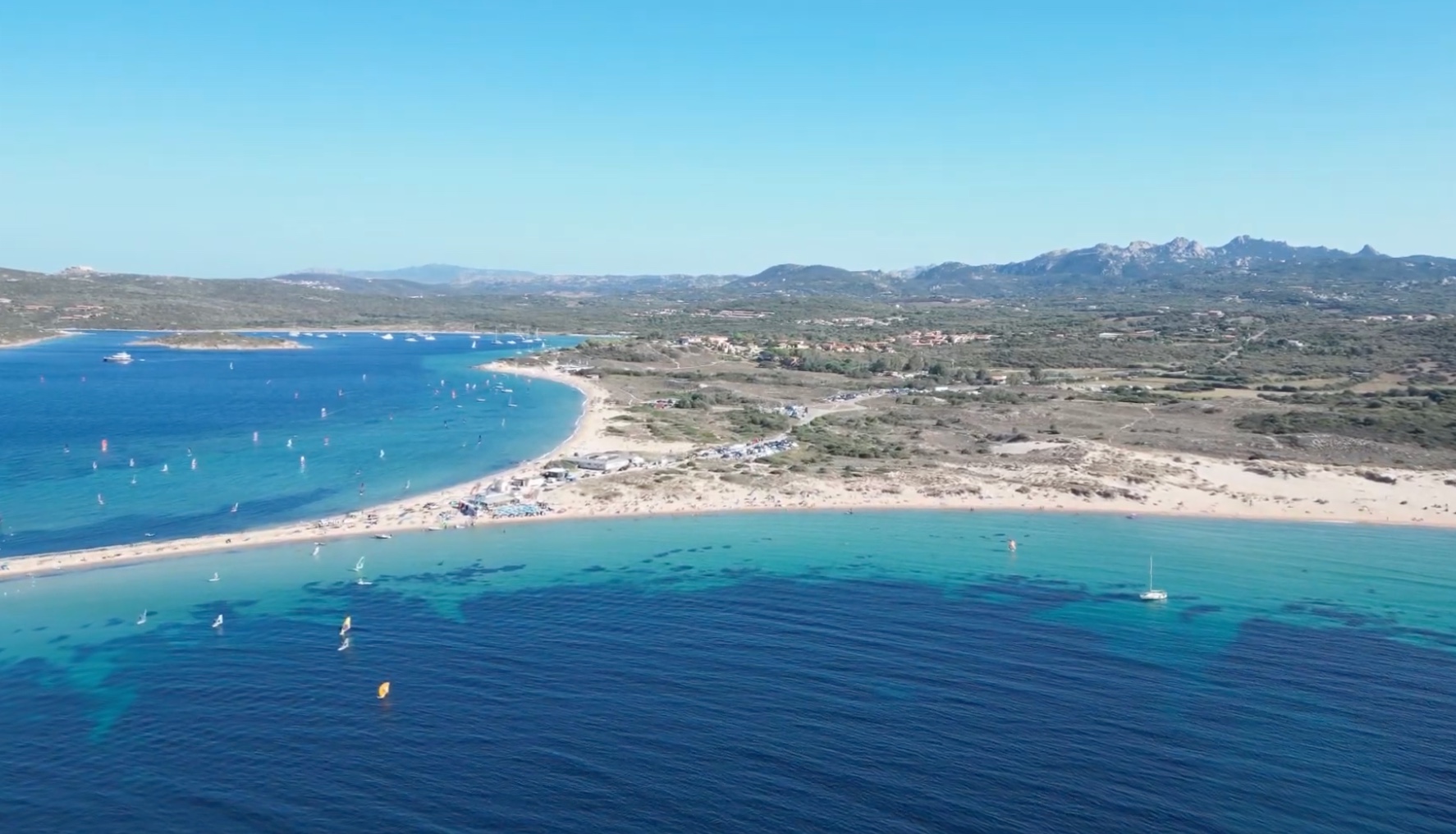
Porto Pollo is the first spot most Sardinia-bound wing riders hear about, and it delivers. A narrow peninsula divides two completely different bays: the east side is sheltered and flat, ideal for learning and progression; the west side opens toward the strait, where the Maestrale arrives with serious venturi kick between Sardinia and Corsica. Schools, rental, food and accommodation are all here. Busy in summer but justifiably so.
Punta Trettu in the southwest is a different animal entirely. Where Porto Pollo is a scenic freeride hub, Punta Trettu is a wind machine: 300 days of wind per year, a lagoon that stays mirror flat at hip depth as far as you can see, and both the Maestrale and Scirocco reinforced by local thermal activity. Entry fee around €10 covers insurance. This is the spot that makes riders plan return trips before they even leave.
Porto Botte sits minutes from Punta Trettu and shares the same extraordinary wind statistics, but spreads the action across three distinct sections of shallow bay. More space, similar conditions, flamingo lagoons in the background. When Punta Trettu gets crowded in August, Porto Botte absorbs the overflow without losing anything in terms of quality.
La Cinta near San Teodoro on the northeast coast is the most scenic entry on this list. Wide crescent beach, turquoise water, white sand: it looks like a postcard and rides like a proper intermediate-to-advanced spot. Both the Mistral from the northwest and Scirocco from the southeast work here. Conditions build fast on windy days, so respect the swell and pick your day carefully.
Best Spots to Learn: Flat Water Wingfoil in Sardinia
Sardinia has two of the best wingfoil learning environments in all of Europe, and several more that deserve far more attention than they get. If you are coming to Sardinia specifically to learn or build your first hours on the water, you are in exactly the right place.
Punta Trettu is the benchmark. Hip-deep flat water, consistent cross-shore wind, near-zero current, and multiple professional schools operating out of the same lagoon. Schools on site include ProKite Sardegna (Duotone official, beginner packages from 6 hours), Kite House Sardinia (IWO certified, accommodation included), and Kite Village Sardinia (Duotone equipped, all levels). Book ahead for July and August.
Porto Botte works alongside Punta Trettu as a flat water alternative with more room to spread out. The middle section of the bay is the flattest and most popular for beginners. Schools operating across this area include Kite House Sardinia and Is Solinas Kite and Wing, which uses the nearby Is Solinas lagoon — an equally flat, even more uncrowded option a few kilometres south.
The east bay of Porto Pollo is one of the most beginner-friendly spots in northern Sardinia — sheltered, sandy-bottomed, and with schools right on the water. FH Academy and MB Pro Center (RRD official, 50+ wings available) both run structured courses for all levels. Wind Porto Pollo has been here since 2000 and offers IKO-certified instruction alongside kite and windsurf.
Posada on the east coast is the hidden gem for learners. The beach faces east, the water is flat inshore, and thermal wind builds reliably through summer afternoons. Nido Surf runs English and German-language courses for all levels with a full rental fleet. Far fewer crowds than the southwest spots — and Camping Ermosa right next to the launch makes logistics effortless.
If you want to go from zero to flying in a week, Punta Trettu gives you conditions that just do not exist at most other spots in Europe. Flat, consistent, forgiving — and when you are ready for more, the wind steps up to meet you.
Kid-Friendly Wingfoil Spots in Sardinia
Sardinia genuinely works as a family destination in a way that few wing spots do. Several spots combine excellent wind and water conditions for riders with wide sandy beaches, shallow swimming areas, and infrastructure for non-riding family members nearby. These are the ones that get repeat visits from families.
Porto Pollo — North Sardinia
The sheltered east bay at Porto Pollo has shallow, calm water that is safe for children to swim and paddle while the rider is on the water. The Isola dei Gabbiani campsite and holiday village sits directly at the spot with bungalows and apartments. The nearby town of Palau has supermarkets, restaurants, and boat trips to La Maddalena National Park. View Porto Pollo on Gusty.
Punta Trettu — Southwest Sardinia
The lagoon at Punta Trettu is hip-deep and current-free — as safe as standing water gets. Children can wade out hundreds of metres from shore while the rider sessions right alongside them. The island of Sant’Antioco nearby has proper beaches, food markets, and a charming old town with Phoenician ruins. Kite House Sardinia offers accommodation right at the water’s edge. View Punta Trettu on Gusty.
Posada — East Coast
Posada is a quieter, more relaxed option for families who want a genuine Italian beach experience alongside the wind sessions. The beach is long and sandy, the sea gets calm in the morning, and Camping Ermosa runs a proper family-friendly setup with bungalows right on the water. Nido Surf runs family lesson packages. View Posada on Gusty.
Torre Grande — Sinis Peninsula
Torre Grande is the city beach of Oristano, with a wide sandy shore, beach bars, and a lively summer atmosphere. It is also the training ground of the Spanu family, Nicolò and Maddalena, both U19 wing foil world champions. Windacademy Sardinia runs lessons here for all levels, including children. Good infrastructure, calm sections away from the wing area, and genuinely impressive company.
Wave Spots: Where to Find the Real Action
Sardinia’s western coast, facing the open Mediterranean, takes the full force of the Mistral and builds some of the most powerful waves in the entire sea. If you wing in waves, these spots belong on your bucket list. If you don’t, file them for when you’re ready.
Capo Mannu is the headline act. A rocky lighthouse headland at the tip of the Sinis peninsula where the Maestrale arrives unobstructed and stacks up two-to-five metre walls across three reef breaks. The sideshore angle is textbook, the wave shape is clean, and on the right day this is as good as Mediterranean wave riding gets. Rocky entry, sea urchins, strong current — experienced riders only. The annual “Capo del Capo” surf competition brings the best wave riders in Italy here every autumn.
Funtana Meiga — The Step-Down
A few kilometres south of Capo Mannu, Funtana Meiga is the spot for riders who want reef wave action without the full Capo Mannu commitment. Three separate rock plateaus create three distinct wave peaks around 300 metres offshore, with one-to-three metre sets and a slightly friendlier entry. Still a rocky coast, still intermediate-plus, but this is where a lot of serious riders actually log their Sinis wave hours. Windacademy Sardinia at Torre Grande occasionally runs wave clinics here.
Chia (Su Giudeu) — The Southern Option
Chia in the far south is known for its white sand beaches and turquoise water, but on west thermal and Maestrale days it delivers proper wave action at the western end of the beach. The conditions are lighter and less committed than Capo Mannu, making Chia a realistic option for intermediate wave riders. In summer (June through August) crowds get intense and launching is done via boat — Wind Wave Club organises the water access. A stunning spot regardless of the conditions.
Seasons: When to Go to Sardinia for Wingfoil
Sardinia is a year-round destination, but the quality of the experience changes dramatically depending on when you go. The prime window runs April to October. Outside that, the wind is often stronger but the water is cold and the wave spots on the west coast take over.
May and September — The Sweet Spot
May and September are the months that experienced Sardinia regulars guard jealously. Wind probability at Punta Trettu and Porto Pollo sits between 75 and 85 percent. Water temperature is 17–23°C, comfortable in a shorty or 3/2 wetsuit. Crowds are a fraction of August. Prices follow suit. If you can go in May or September, go in May or September.
July and August — Peak Reliability, Peak Crowds
The southwest spots hit their most reliable thermal wind in high summer, Punta Trettu and Porto Botte regularly see 90 percent wind days in July and August as the thermal kicks in every afternoon without fail. Water is 24–26°C, boardshorts weather, and the wing scene is buzzing. The flip side: accommodation prices peak, the spots get crowded, and you will be fighting for water space at Punta Trettu by 14:00. Book everything early if this is your window.
Winter — Wave Season on the West Coast
October through April belongs to Capo Mannu and Funtana Meiga. The Maestrale cranks up, swells arrive from the Atlantic-fed Mediterranean fetch, and the wave breaks on the Sinis peninsula fire properly. Water temperature drops to 14–17°C so a 4/3 wetsuit is essential. The island is quiet, accommodation is cheap, and the wave spots are at their absolute best. If you are a wave rider with flexibility on dates, this is the version of Sardinia most people never see.
May or September for your first trip. October for your second. If you go in August you will have the time of your life, but you will spend the next year recommending May and September to everyone who asks.
The Different Coasts of Sardinia
Sardinia is big enough that the four coasts feel like four separate islands. Each coast has a different wind exposure, different character, and different best season. Understanding this before you go determines whether you end up at the right spot for the right conditions.
North — Bocche di Bonifacio
The north coast is defined by the Bocche di Bonifacio — the strait between Sardinia and Corsica that channels and accelerates the Maestrale to serious speeds. Porto Pollo sits right in this acceleration zone and gets the venturi effect at its most obvious. The northern coast also works with Tramontana (N) and occasionally Scirocco. Best from April to October, with July and August seeing near-daily wind. The water here is some of the most spectacular in the Mediterranean.
East Coast
The east coast is Sardinia’s underrated side. Spots like Posada and La Cinta (San Teodoro) receive a mix of thermal wind, Maestrale from the northwest, and Scirocco from the southeast. The water tends to be calmer than the western coast and the crowds are significantly thinner. The east is best from May through September when the thermal is most reliable. La Cinta picks up proper chop and wave action when the Scirocco arrives; Posada stays flat and consistent throughout summer.
West Coast — Sinis Peninsula
The Sinis peninsula faces directly into the unobstructed Mediterranean and takes the Maestrale full force. This is Sardinia’s wave coast — Capo Mannu, Funtana Meiga, and a series of smaller breaks between Putzu Idu and Torre Grande. Summer brings lighter thermal conditions with some flat water potential at Mare Morto lagoon near Putzu Idu. Autumn through spring is when this coast comes alive with serious swell. The Windacademy Sardinia trains world champions here for a reason.
South and Southwest — The Wind Machine
The southwest is where Sardinia’s reputation is built. The Sulcis region — Punta Trettu, Porto Botte, Is Solinas, Porto Pino — receives both the Maestrale and Scirocco, both amplified by the Venturi effect between Sardinia and the island of Sant’Antioco, and both further boosted by afternoon thermal activity from the surrounding hills. The result is wind on 300-plus days per year. Flat, shallow water. Multiple professional schools. This is the southwest corner that makes Sardinia one of the top five wingfoil destinations on the planet.
Wingfoil Cruises and Boat Trips in Sardinia
The north of Sardinia borders one of the world’s great sailing areas — the Bocche di Bonifacio strait, the La Maddalena archipelago, and the southern coast of Corsica. Several operators run dedicated wingfoil cruises through this area, combining catamaran sailing with wing sessions at remote spots inaccessible from land. It is one of the best ways to cover Sardinia’s greatest hits in a single week.
Ocean Ad Ventures — Sardinia and Corsica Wingfoil Cruise
Ocean Ad Ventures runs week-long catamaran trips through Sardinia and Corsica on a solar-powered boat with private cabins. All levels welcome, gear rental available on board, and the itinerary hits secret anchorages alongside Porto Pollo. Includes coaching, meals, SUP, and snorkelling.
Watersports Training — Duotone EOLO Catamaran
Watersports Training operates the Lagoon 450F catamaran “EOLO” — Duotone’s official yacht — on a Costa Smeralda to Bonifacio circuit with maximum 8 guests. A chef on board four nights per week, IKO instructor, Duotone wing and foil gear available to rent, and drone media coverage. The premium option on this list.
The Action Cruise — Kite and Sail Camp
The Action Cruise runs 6 to 9 day trips departing from Cannigione (near Olbia) in May, June, September and October. The itinerary covers Olbia, La Maddalena, Porto Pollo, and south Corsica. North Kiteboarding gear on board, drone coverage, three meals per day. Intermediate and advanced riders; maximum one beginner per trip.
360 Kite Travel — Corsica-Sardegna Cruise
360 Kite Travel operates a Nautitech 46 Fly Bridge catamaran on a 6 or 9-day Corsica-Sardinia circuit running April through October. All levels accepted, structured coaching included, downwind sessions, drone media, and all meals on board. 360 Kite also runs a land base at Sant’Antioco lagoon in the southwest for those who prefer spot-based lessons.
A week on a catamaran through the Bocche di Bonifacio is not a wing holiday. It is a wing holiday plus a sailing trip plus a Mediterranean island-hopping adventure. Few combinations hit as hard.
The Winds of Sardinia
Sardinia has eight named wind systems and a thermal layer on top of that. Understanding which wind is blowing on any given day determines which coast works, how strong it will get, and whether conditions will hold through the afternoon. Here is the breakdown.
Maestrale (Mistral) — NW
The Maestrale is the king. A northwest wind that arrives cool, dry, and powerful from continental Europe and the Gulf of Lion, funnelling through the Bocche di Bonifacio with added force. It can blow for two to five days without stopping, typically 15 to 35 knots at the main spots. The Maestrale is strongest in autumn, winter, and spring; it eases off in summer but is replaced by thermal. Almost every wing-able day in Sardinia runs on some version of the Maestrale.
Scirocco — SE
The Scirocco blows from the southeast, warm and sometimes humid, originating over the Sahara and crossing the Mediterranean before hitting Sardinia. It is the second most important wind for wingfoil, turning on the southwest spots (Punta Trettu, Porto Botte) from the opposite direction to the Maestrale. Scirocco is most common in the transition seasons — spring and autumn. It can deliver clean conditions but sometimes carries a dusty haze from the Saharan crossing.
Tramontana — N
The Tramontana is a cold, strong north wind that arrives mainly in winter, sometimes exceeding 50 knots at exposed spots like Punta Trettu. It is not a wind to take lightly — it arrives fast and can build significantly over a short period. Winter riders who know it well can score extraordinary conditions; everyone else should check the forecast obsessively and have an exit plan.
Thermal Wind — The Summer Secret
From May through October, the temperature difference between the sun-heated land and the cooler sea generates a reliable thermal wind that starts building mid-morning and peaks in the early afternoon. At Punta Trettu and Porto Botte this thermal combines with the Maestrale and the local Venturi to push daily wind probability close to 90 percent in July and August. Even on days when the synoptic forecast shows nothing, the thermal fires. It is the mechanism that makes the southwest the most reliable wing region in the Mediterranean.
Libeccio, Grecale, Levante
The Libeccio (SW) is a warm, occasionally aggressive wind that works the south coast — Cagliari’s Poetto beach and the Capoterra area run on it in summer. The Grecale (NE) is a cool, gusty wind most common on the northern coast and useful at spots near the Bocche di Bonifacio. The Levante (E) is milder and less common but creates wave conditions along the east coast around Villasimius and Porto Giunco.
Frequently Asked Questions
What is the best month to wingfoil in Sardinia?
May and September offer the best balance of wind reliability, water temperature, and manageable crowds. July and August are the most wind-reliable months (especially at Punta Trettu and Porto Botte) but are also the busiest and most expensive. For wave riding, October through March on the west coast is the season.
Is Sardinia good for beginner wingfoilers?
Yes — Punta Trettu and Porto Botte in the southwest are among the best learning spots in all of Europe. The flat, shallow, current-free lagoon at Punta Trettu combined with near-daily wind is difficult to beat for first-time progression. Multiple professional schools operate on site. The east bay at Porto Pollo and Posada on the east coast are also excellent beginner spots.
Do I need to rent gear or can I bring my own?
Both options work. Multiple schools at Porto Pollo, Punta Trettu, and Porto Botte have extensive rental fleets covering all sizes — skip the airline baggage fees and rent on site. If you do bring your own gear, check current airline policies for wing and foil bags. Ferry connections from the Italian mainland are the easiest option for bringing a full quiver.
Sardinia does not need hype. It just needs the right conditions, and it delivers those on 300 days a year. Find your spot, book your school, and go. <a href="/explore" style="color:inherit;text-decoration:underline">Browse all Sardinia wingfoil spots on Gusty.</a>
Written by
Reinoud
Wingfoiler, lifelong windsurfer and kiter and founder of GUSTY. Based in Muiderberg, on the water at Wijk aan Zee, Muiden, Almere Poort and all over Zeeland.
More about Reinoud →